

No Apologies.
We all start somewhere, but we shouldn't stay there.

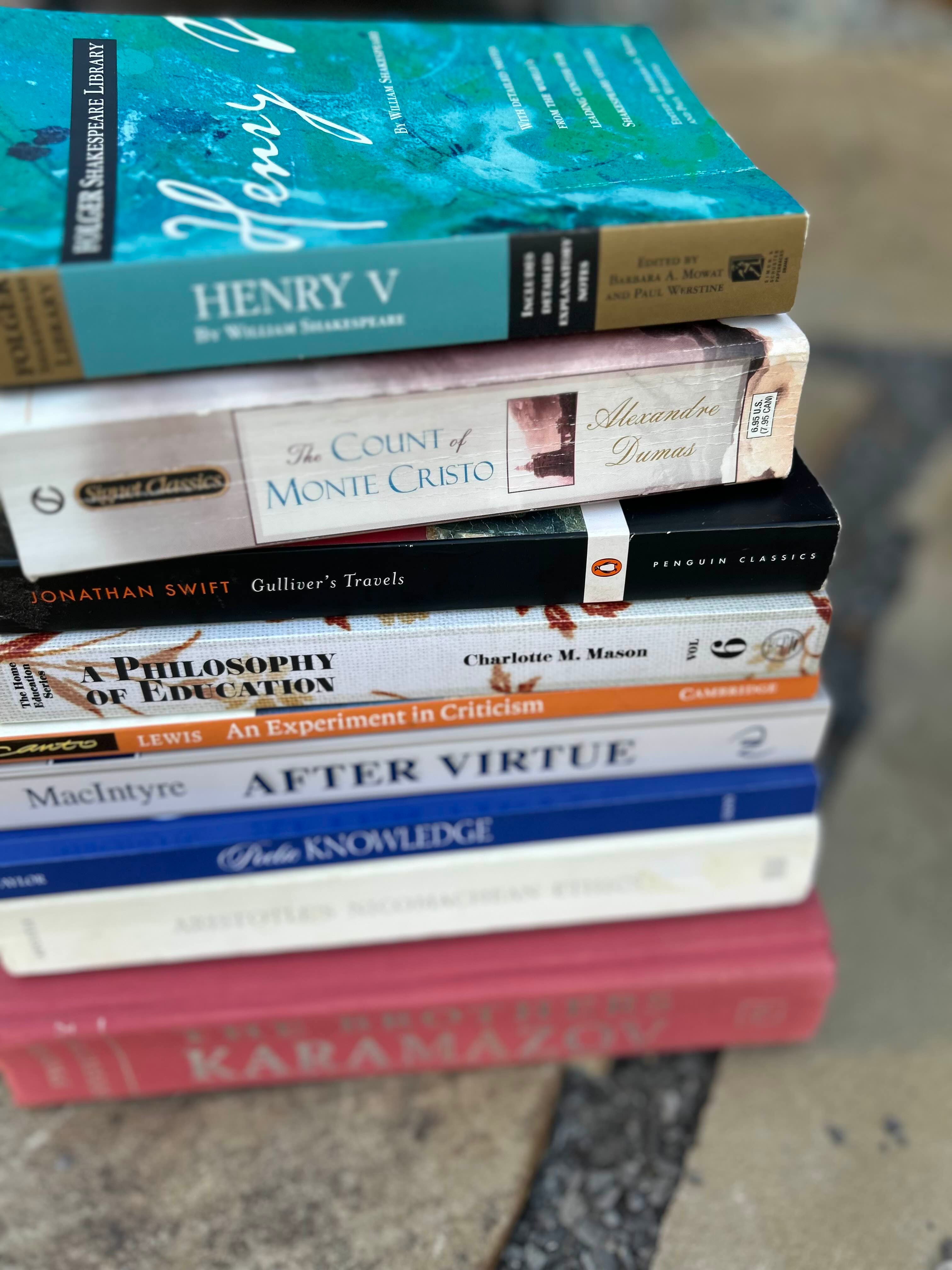
When I travel to schools and conferences, I meet a lot of teachers. We grab a burger and talk about curriculum changes and coaching. We linger after the session and talk about raising kids who play sports, but also go to church and attend a classical school. In these conversations, I try to help teachers take the next step by first understanding where they’re at and where they want to be. Becoming a good classical teacher is akin to the life of a saint, a “lifetime of death in love.” You can’t expect to take six online courses and have it all figured out. You can’t expect to read one book on parenting and craft your game plan. Learning how to live like a saint takes a lifetime.
So instead of putting new teachers through a whirlwind of courses on pedagogy and philosophy that will leave them anxious and confused, I prefer to encourage all teachers to grow. I like to say: no one needs to apologize for where they start, they only need to apologize if they decide to stay there. If teachers are to be worthy of imitation, then we had better keep learning how to love deeply and put to death unlovely affections.
All new teachers start somewhere. But no new teacher should stay there. We can all commit to becoming better teachers by becoming better students.
One of the ways I encourage teachers to take that next step is by asking them what part of their curriculum do they need to learn to love better? Or, what work in the classical tradition do they need to read for the first time? If we are honest with ourselves, we all have a book we don’t really love to read with our students or a unit that we wish we didn’t have to teach. If we are really honest with ourselves, we all have a book we hear mentioned on podcast after podcast or at conference after conference that we have never bothered to read.
I have this list. Your lead teacher has this list. Even your headmaster has this list. We are all learning how to live by learning how to love the right things in the right way for a long time. So, here’s my answer to that second question. Here are ten books that I have never read, but which are important to the classical tradition. These are books I hear referenced often, books that influenced other books, books I haven’t bothered to read until now. There are things I have yet to learn, and I want to take the next step. Will you join me? What book will you read in 2026 that will help you better love the curriculum you teach and the tradition you represent? Post your answer in the comments. I’d love to hear from you!
Mandi’s 2026 Classical Education Reading List:
Nicomachean Ethics, Aristotle
From this book, we get the idea that a virtuous man performs virtuous deeds. In it, Aristotle discusses intellectual and moral virtue as action. He also talks about the power of habit formation related to virtue. Since one of the distinctives of classical education is the cultivation of virtue through habit formation, it’s time to go to the primary source and dive in.
Begin Here: The Forgotten Conditions of Teaching and Learning, Jacques Barzun
As I read more of Donald and Louise Cowan’s work, I frequently come across quotations they reference from Jacques Barzun. Just today, I read a delightful letter Louise wrote to him in 1991 sharing how much she enjoyed an essay included in this work, which is now out of print and therefore not pictured.
Brothers Karamazov, Fyodor Dostoyevsky
Remember we are not apologizing for where we are? I have never read Brothers K. and that’s embarassing. In a lecture on the book in 2003, Louise Cowan said, “The Brothers Karamazov represents Dostoevsky’s solution to the search that his entire life represents. As an educated man, an intellectual, even in a backward Russia, he was preoccupied with the question of God’s existence–and even more, with the question of Christ’s redemption of the human. He had tried to depict what the follower of Christ must be like.” The Norton Critical Edition was the one she listed on a 2006 syllabus, so that’s the one I’ll be reading.
The Count of Monte Cristo, Alexandre Dumas
Two of my sons number this book among their favorites, and a teacher I used to work with loved it equally as well.

Sean Berube says, “Alexander Dumas offers one of the richest meditations on what it means to live a meaningful life — and he does so through the eyes of a man languishing away in a prison cell, staring into the clutches of death.”
An Experiment in Criticism, C.S. Lewis
Because we are so focused on recovering the reading of great books in classical education, we might be unaware of the schools of thought or methods of criticism that used to dominate the study of literature. These approaches became a high gate that kept regular people from reading great literature. Louise Cowan developed an entire theory on literary genre in order to help people read more experientially and less critically. I look forward to reading for what Lewis and Cowan have in common in their approach to reading and teaching great books.
After Virtue, Alasdair MacIntyre
At the CiRCE Summer Conference, Tim McIntosh gave a lecture on this book to a packed room. Thirty charming and nerdy adults (myself included) hung on his every word. I was there even though I hadn’t read the book. Maybe I was wondering what all the fuss was about. I left convinced that this is a book classical education will be referencing more and more in the immediate to near future.
A Philosophy of Education, Charlotte Mason
Of Miss Mason’s six volumes, I’ve only read School Education from cover to cover. However, I have read Karen Glass’s Know and Tell and Consider This, as well as Jason Barney’s A Classical Guide to Narration. When I listened to this podcast on Classical Et Cetera and a response to it on the Charlotte Mason Poetry Podcast, I knew it was time to read more about Charlotte Mason’s philosophy of education from her own words.
Henry V, William Shakespeare
Remember how I said we all have things we are learning to love? I’ve read maybe one of Shakespeare’s history plays. I want to deepen my love for Shakespeare by reading more than my favorites and more than the one I regularly teach. Also, the Saint Crispian’s Day Speech from Henry V is one often memorized in classical schools.
Gulliver’s Travels, Jonathan Swift
When I read that Kathleen O’Toole was teaching Gulliver’s Travels this year at Hillsdale Academy as part of her moral and political philosophy course, I immediately wanted to read it. Since then, I’ve seen that

Karen Swallow Prior is leading a reading group on it. I admire both O’Toole and Swallow Prior, so I am interpreting this as a sign that now is the time for me to read Swift’s work.
Poetic Knowledge, James S. Taylor
My own thoughts about symbolism and metaphor and the need to see the world imaginatively come from numerous sources. But I have not, as of yet, gone to the true source on this topic, Taylor’s Poetic Knowledge, where he states, “that the end of knowledge would be to possess a vision of beauty and perfection above the object of the senses that would lead us to the contemplation of God.” Because without a “judgement of the senses” learning “tends to become dehumanized and increasingly destructive.”
Share with me in the comments the book you want to read in 2026 to help you more confidently wear the Western tradition like a robe and a mantle.
Where Mrs. Gerth is speaking:
Chesterton Academy of Our Lady of Victory, Centennial, CO, January 5, 2026
Arma Dei Academy, Highlands Ranch, CO, January 5-6, 2026
Labore, Brasilia, Brazil, January 12-16, 2026
Great Hearts Arlington, Arlington, TX, February 6, 2026
Great Hearts National Symposium, Tempe Mission Palms Hotel, AZ, February 25-27, 2026
Oak Hill Classical, Dacula, GA, March 2, 2026
Northwest Classical Academy, Kennesaw, GA, March 3, 2026
What Mrs. Gerth is teaching:
The Thales College Certificate in Classical Education Philosophy Program(CCEP) consists of eight courses taken in any order, culminating in a certificate. Courses cost just $300 each and are held through Google Meet once every other week. Register by January 5. Classes begin January 13.
Louise Cowan on Greek Tragedy Spring Seminar at the University of Dallas. Five Thursday evenings on Zoom from 6-8 PM: January 22, 2026 - March 26, 2026
Enjoyed this post? You can buy me a coffee, buy my book, buy its study guide, or follow me on Instagram and LinkedIn.
Mandi, that line stopped me: “no one needs to apologize for where they start, they only need to apologize if they decide to stay there.”
Most of what I read is necessary for my work, technical documentation, incident notes, troubleshooting threads. It’s useful, but it’s also ephemeral: intensely relevant for a moment, and then replaced by the next urgent thing. Your sentence felt like a gentle but firm correction for me. Starting where I am is fine, choosing to remain there is not.
I already have one book on my shelf that I still haven’t opened, Schopenhauer’s The Art of Being Right, and your list is the push I needed to expand beyond my “work-only” reading habits. This year, I want to take the next step and become a better student, not just a more efficient technician.
Thank you for helping me begin to knock off some books on my list this past semester! I needed the renewal as I felt I had gotten bogged down in the minutia of running a school. It’s been a breath of fresh air.