

The Magic Formula
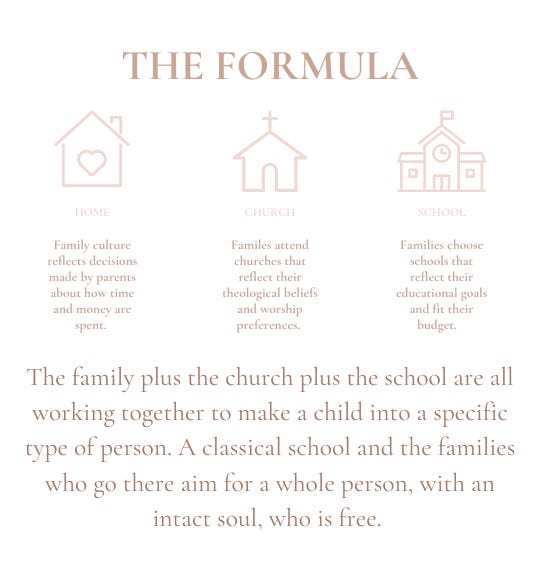
What formula is your school using to produce its students? A classical school will have one formula and one formula only. Family + Church + School = A Free Person

There are a lot of things to consider when you choose a school. Uniforms or no uniforms. Sports teams or no sports teams. Which sports teams? College prep? College guidance? Five day or Collaborative?
A school can be any of those things without being classical. So, while a classical school will have answers to those questions, those answers will not tell you if a school is classical, why they are classical, and how classical they are.
But there are two things that will.
The Magic Formula
First, what formula is the school using to produce its students? A classical school will have one formula and one formula only. Family + Church + School = A Free Person
Your family has a culture. It is made up of the decisions you make in your home about what you will spend your time doing and your money pursuing.
You also attend a church with a certain point of view on everything from baptism and communion to pop culture and youth group. And you chose it for those reasons.
Finally, your children attend school. I intentionally ordered it that way. School ranks third.
Your family plus your church plus your school are all working together to make your child into a person. A classical school and the families who go there aim for a whole person, with an intact soul, who is free. This is the goal of a liberal education, which is the aim of a classical school, to make a free person.
The weakness of any one of the three impacts who your child becomes because it changes the formula.
The War Chest
Second, a school has three weapons in its war chest: atmosphere, ideas, and habits. That’s it. That’s the whole of its weaponry.
Atmosphere is the environment or the culture of the school. It is made up of things that are intangible and things that are embodied. Both communicate to your students, in a myriad of ways, what the school believes is important. The choices a school makes about technology, ceremony, discipline, extracurriculars, and routines all contribute to its atmosphere.
Next, in its arsenal is the commitment to living ideas. In a classical school, great books are read for their ideas, not merely for their difficulty. Class discussions are arranged to wrestle with those ideas. Students are expected to interact with a text personally and thoughtfully. There will be a lot of reading of hard books that are old, but not just because they are hard and old.
Once the books have been read, students will be asked to speak and write eloquently about the ideas encountered in those books. This also will demand a lot from the student, but it will produce a certain kind of person. Because a truly free person, who is not enslaved to the lies of the world in which he lives, must know how to see an idea for what it is, compare it to the truth of scripture, and argue for or against it—logically and eloquently. Only when a man is able to do those things is he truly free.
Finally, a classical school labors to inculcate habits to order loves and form virtue. Certain practices are repeated daily, weekly, quarterly. The aim or end of all that repetition is to form a person by passing on to her what is most important and most beautiful about the world in which she lives and about the God whom she worships.
Choose to prepare, not to hide
Parents, you truly are at war for the hearts, minds, and souls of your children; and choosing a classical christian school is part of how you must wage that war. But a classical christian school is not a cushy, safe place to hide from the world. Rather, it is a training camp where students are prepared for battle.
Our children are living in a world where they must fight hard for basic human liberty—the right to care for their souls and the right to free their minds from the shackles of misinformation and anxiety. A classical education frees a man by equipping him to do battle against the world, the flesh, and the devil with the timelessly effective weapons of reason, imagination, and joy.
Repairing the Ruins, June 20-22
I will be presenting more on how families and teachers work together to build free persons at Repairing the Ruins in Atlanta. Please come say hi. I’d love to meet you and find out more about the work you are doing in classical education.
Summer Reading Book Clubs
Several opportunities are available this summer for your student to participate in thought provoking discussions about their summer reading. Find out more.